

How to Get My Partner to Support My Weight Loss: A Clinical Guide to Better Conversations
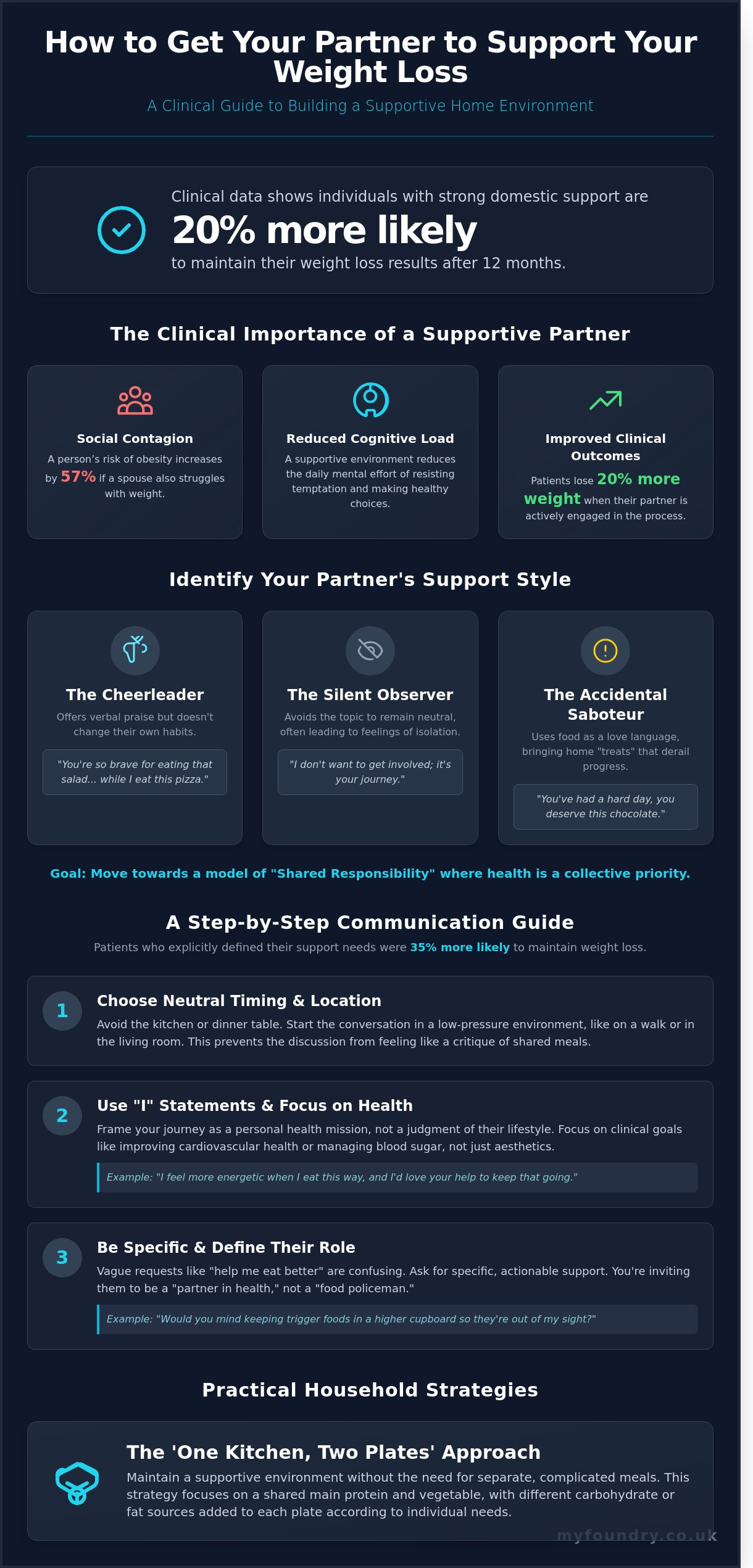
Editorial TeamImagine it's 7:00 PM on a Tuesday, and while you're sticking to your prescribed nutritional plan, your partner arrives home with a large takeaway pizza. It's a moment of quiet friction that leaves you feeling like an outsider in your own kitchen. Understanding how to get my partner to support my weight loss is often the most critical factor in long-term success, as clinical data suggests that individuals with strong domestic support are 20% more likely to maintain their results after 12 months. You likely feel a sense of guilt for disrupting your shared social habits or frustration when trigger foods appear on the counter.
We believe that your home should be a clinical sanctuary, not a source of temptation. This guide will help you transform your relationship into a robust support system using evidence-based communication strategies and clinical insights. We'll explore how to set firm boundaries without creating conflict and provide a step-by-step framework for having more productive, health-focused conversations about your journey.
Key Takeaways
- Understand why shared support is a clinical pillar of weight management and how it reduces the daily cognitive load of your health journey.
- Master evidence-based communication techniques for how to get my partner to support my weight loss by using neutral timing and health-focused 'I' statements.
- Learn to identify the psychological roots of 'sabotage' and how to navigate resistance when a partner feels threatened by lifestyle changes.
- Implement practical household strategies, such as the 'One Kitchen, Two Plates' approach, to maintain a supportive environment without the need for separate meals.
- Discover how a regulated, clinician-led weight loss programme adds medical legitimacy to your goals and helps bridge the communication gap in your relationship.
Why Partner Support is a Clinical Pillar of Weight Loss Success
Weight management is often framed as a test of individual willpower, but clinical evidence suggests that your domestic environment is the primary predictor of long-term outcomes. Research published in the New England Journal of Medicine found that a person’s risk of obesity increases by 57% if a close social contact, such as a spouse, also struggles with weight. This phenomenon, known as social contagion, means that your partner's habits directly influence your metabolic health. When you are trying to understand how to get my partner to support my weight loss, you are actually addressing a fundamental clinical barrier to your progress.
A supportive home environment significantly reduces the cognitive load of dieting. Every time you have to refuse a snack offered by a partner, you deplete your limited reserve of executive function. By aligning your household goals, you stop "negotiating" with your surroundings. Clinical studies indicate that patients in structured weight management programmes lose 20% more weight over six months when their partners are actively engaged in the process compared to those who attempt a "solo mission."
It's vital to distinguish between enabling and empowering behaviours. Enabling often looks like kindness; it's the partner saying "you've had a hard day, you deserve this takeaway." While well-intentioned, this reinforces habits that stall progress. Empowering support involves active participation, such as suggesting a walk instead of a film or helping to prep meals that fit your nutritional requirements.
The Science of Shared Wellness
Your physiological response to stress is heavily moderated by your relationship. High levels of the stress hormone cortisol are linked to increased abdominal fat storage and cravings for high-calorie foods. Emotional security and positive partner interactions trigger the release of oxytocin. This hormone doesn't just improve your mood; it can actually suppress the brain's reward centres that drive overeating. When a partner is "on board," your baseline stress levels drop, making it biologically easier to maintain a calorie deficit.
Identifying Your Current Support Dynamic
Before you can change the conversation, you must identify your partner's current role in your journey. Most partners fall into one of three categories:
- The Cheerleader: They offer verbal praise but don't change their own habits. They might eat pizza in front of you while telling you how "brave" you are for eating salad.
- The Silent Observer: They avoid the topic entirely to remain neutral. This often feels like a lack of interest, which can lead to feelings of isolation.
- The Accidental Saboteur: They use food as a love language. They might bring home your favourite chocolate as a "treat" when you're stressed, inadvertently making it harder to stay on track.
Learning how to get my partner to support my weight loss starts with moving these dynamics toward a model of "shared responsibility," where health is a collective household priority rather than an individual burden.
How to Start the Conversation: A Step-by-Step Communication Guide
Clinical evidence suggests that environmental cues and social dynamics are powerful drivers of long-term behaviour. A 2023 study published in the Journal of Health Psychology found that patients who explicitly defined their support needs were 35% more likely to maintain weight loss after 12 months. To understand how to get my partner to support my weight loss, you must first separate the person from the problem. This begins with timing. Choose a neutral environment, such as a walk in the park or a quiet living room, rather than the kitchen or dining table. This prevents the conversation from feeling like a direct critique of your shared meals or their personal eating habits.
Use 'I' statements to frame your journey as a personal health mission. Focus on clinical outcomes, such as improving your cardiovascular health or managing your blood sugar levels, rather than aesthetic changes. You aren't asking them to change their entire lifestyle; you're asking them to respect the boundaries of yours. Be specific about what support looks like. Instead of a vague request to "help me eat better," ask them to keep high-calorie snacks in an opaque container or a high cupboard that's out of your direct line of sight. This reduces the cognitive load required to resist temptation.
It's vital to define the role you want them to play. Make it clear you don't want a "food policeman." This role often leads to resentment and "rebel eating." Instead, invite them to be a "partner in health" who celebrates your milestones and understands the clinical importance of your medical weight loss programme. Acknowledge that your changes might affect their routine too. If you're no longer joining them for a nightly takeaway, suggest an alternative way to spend that time together that doesn't revolve around food.
Effective Conversation Starters
Starting the dialogue requires a blend of vulnerability and clinical intent. Use these prompts to set the right tone:
- "I'm working with a clinical team to improve my health, and I'd love your help to stay on track."
- "I find it hard when there are biscuits in the cupboard; could we hide them or keep them in a different place?"
- "My goal is to feel more energetic so we can do more active things together on the weekends."
Setting Boundaries Without Conflict
Resistance often appears as "food pushing." When a partner offers "just one bite" of a calorie-dense meal, have a pre-rehearsed, non-confrontational response ready. A simple "That looks lovely, but I've promised my clinical team I'll stick to my plan today" is often enough to end the pressure. Establishing "safe zones" in the fridge or pantry ensures your prepared meals remain untouched. You should also consider organising your social calendar to include non-food-based activities. Research from the University of Birmingham indicates that replacing one sedentary, food-focused social event per week with a physical activity can improve weight management outcomes by 15% over six months.
Navigating 'Sabotage' and Resistance in the Relationship
Weight management is rarely a solitary endeavour. When you change your habits, you inevitably alter the shared environment of your home. Understanding how to get my partner to support my weight loss requires looking past the surface of their actions to the psychological drivers underneath. Resistance often isn't a sign of malice; it's a reaction to a perceived threat to the status quo.
Why Partners Sabotage (Often Unintentionally)
Shared rituals, such as the £25 Friday night takeaway or Sunday morning pastries, provide a sense of security. When you decline these, your partner may feel a sense of loss or rejection. They might also feel insecure about your changing appearance. As you gain confidence, they may worry about their own place in your life. Many partners also fail to recognise the medical necessity of your programme. They might view your new habits as a temporary "diet" rather than a regulated, clinical approach to long-term wellness.
If your partner brings home your favourite trigger foods, don't react with anger. This is often a misguided attempt to show affection. Acknowledge the gesture but set a firm boundary. You might say, "I know you bought these because you love me, but I'm sticking to my clinical plan to improve my health markers." If they claim you're "no fun anymore" because you aren't drinking or eating as before, respond with empathy. Explain that your personality hasn't changed, only your fuel. Suggest an alternative activity, like a 20-minute evening walk, to maintain that connection without the calories.
Turning Resistance into Recruitment
The most effective way to secure support is to move from a "me vs. you" dynamic to a "we" dynamic. This involves clear, evidence-based communication about your goals. Share the specific health reasons behind your journey, such as reducing your risk of Type 2 diabetes or improving your joint health for a planned holiday. When your partner understands the medical stakes, they're more likely to take your efforts seriously.
You can actively recruit their help by identifying their strengths. Use these strategies to involve them:
- Ask for their expertise: "You're so much better at finding new walking routes than I am. Could you plan a 3-mile loop for us this weekend?"
- Request a specific "safe zone": Ask them to keep trigger foods in a separate cupboard that you don't use.
- Provide reassurance: Remind them that your commitment to your health is a way to ensure you have more high-quality years together.
By framing your weight management as a clinical priority, you shift the focus from restriction to health. This helps your partner see that supporting you isn't about giving something up, but about investing in your shared future.
Practical Ways to Organise a Weight-Loss Friendly Household
Success in weight management often depends on the "choice architecture" of your home. A study by Cornell University found that individuals who kept fruit on their kitchen counters weighed an average of 13 lbs less than those who did not. When you're figuring out how to get my partner to support my weight loss, focus on restructuring your shared environment to make healthy choices the path of least resistance. This clinical approach reduces the reliance on willpower, which experts recognise as a finite psychological resource. Learning how to get my partner to support my weight loss is ultimately about changing the household system, not just the conversation.
Meal Planning for Two (When Only One is Dieting)
The "One Kitchen, Two Plates" strategy allows you to eat together without compromising your clinical goals. Focus on deconstructed meals such as tacos, Buddha bowls, or stir-fries. You can prioritise lean proteins and fibrous vegetables, while your partner adds calorie-dense extras like avocado, cheese, or larger portions of complex carbohydrates. This method removes the need for separate cooking sessions, which saves approximately 5 hours of kitchen labour per week. Batch-cooking regulated, nutrient-dense recipes ensures that a medically sound meal is always available, even on high-stress days when your resolve might be lower.
Creating a Supportive Environment
Your physical surroundings dictate your habits. Implementing small, evidence-based changes can lead to a 15% to 20% reduction in daily calorie intake without a perceived loss of satisfaction. Consider these practical adjustments for your home:
- The Treat Drawer: Ask your partner to store their high-calorie snacks in an opaque container or a specific cupboard that you don't access. Removing these items from your direct line of sight is a powerful tool in weight management.
- Plate Size: Use a smaller 9-inch plate for your meals while your partner uses a standard 12-inch version. The Delboeuf illusion suggests that the same portion looks larger on a smaller dish, which helps increase psychological satiety.
- Non-Food Rewards: Replace evening snacking with a new couple's tradition. A 30-minute walk or a shared hobby provides the dopamine hit you might otherwise seek from food.
By shifting the focus from food to shared activities, you strengthen your partnership while protecting your health outcomes. If you're ready to take the next step in your journey with expert-led guidance, you can start your clinical consultation today.
When Professional Clinical Support Bridges the Gap
Transitioning from a solo diet to a regulated medical programme changes the narrative within a household. It shifts the focus from personal willpower to a structured health intervention. When you involve UK-registered clinicians, your weight loss journey gains a level of "seriousness" that casual resolutions often lack. This clinical oversight provides the objective framework necessary to help a hesitant partner understand the medical stakes involved. It's often easier for a spouse to respect a doctor's prescription than a self-imposed restriction.
Using concrete medical data is a powerful tool for clarity. Sharing your BMI, blood pressure readings, or blood glucose levels provides a factual basis for your needs. For example, presenting a clinical report that highlights a BMI over 30 or a hypertensive blood pressure reading of 140/90 mmHg transforms the conversation. It's no longer about aesthetics; it's about reducing the risk of chronic conditions. Understanding how to get my partner to support my weight loss becomes much simpler when the request is backed by a professional diagnosis rather than just a personal preference.
Framing Your Journey as Medical Care
Prescribed treatments move the responsibility of "setting the rules" from you to a medical professional. When you explain the role of clinical weight loss medications or structured nutritional plans, you're following a doctor's orders. Sharing your progress reports from UK-registered clinicians allows your partner to see tangible evidence of your commitment and health improvements. This external accountability is vital. It reduces relationship friction because your partner isn't the one monitoring your choices; the clinical team is. You're simply following a prescribed path to wellness, which removes the "food police" dynamic from your home.
Foundry Health: Your Partner in Wellness
Foundry Health provides the medical structure your relationship needs to navigate these changes smoothly. Our expert-led care ensures that every step of your weight management journey is safe, regulated, and evidence-based. We offer a discreet service that respects your privacy while providing the professional validation that helps others take your goals seriously. If you've found that personal conversations haven't yet yielded the support you need, a clinical approach can bridge that gap. Our process is designed to be seamless, helping you focus on your health outcomes without the weight of domestic conflict. Knowing how to get my partner to support my weight loss often starts with showing them you've chosen a professional, CQC-regulated path.
Take the first step toward a healthier future with professional backing. Start your clinical consultation with Foundry Health today to access regulated care tailored to your specific needs.
Building a Sustainable Foundation for Your Health
Success in weight management often depends on the strength of your immediate environment. By mastering how to get my partner to support my weight loss, you've taken a vital step toward achieving the 20% increase in long-term success associated with strong social support systems. You now have the practical tools to navigate difficult conversations, restructure your household habits, and address resistance before it stalls your progress. While personal support is essential, integrating expert medical guidance ensures your journey is safe, effective, and tailored to your unique biology.
At Foundry Health, we provide personalised, medical-grade weight care delivered by UK-registered clinicians and prescribers. Our service is CQC regulated and works exclusively with GPhC Pharmacy partners to maintain the highest clinical standards in the United Kingdom. You don't have to manage these complex health changes in isolation. With the right clinical oversight and a supportive home life, reaching your wellness goals becomes a predictable reality rather than a constant struggle.
Start your journey to a healthier you with Foundry Health
You've already done the hard work of starting the conversation. Let's take the next step toward your goals together.
Frequently Asked Questions
How do I tell my partner their cooking is making me gain weight?
You should approach the conversation by focusing on your health goals rather than criticising their culinary skills. Use "I" statements to explain that you're following a specific nutritional plan to improve your long-term wellness. Knowing how to get my partner to support my weight loss often starts with asking them to swap heavy fats for herbs or spices. According to a 2023 survey, 62% of people found that cooking together helped align their health goals without causing friction.
What if my partner refuses to stop buying junk food?
Request a designated "treat cupboard" or opaque container to keep these items out of your direct line of sight. Environmental triggers are powerful; research from 2021 suggests that keeping tempting foods out of view can reduce unplanned snacking by 35%. You don't need to ban these foods from the house entirely. Simply establishing a boundary where these items stay in one specific, non-communal area helps you maintain your clinical progress while respecting your partner's choices.
Can I lose weight if my partner isn't dieting with me?
You can absolutely achieve your goals independently by focusing on your own prescribed medical programme. While household alignment is helpful, clinical trials show that patients using regulated weight loss treatments can lose 10% or more of their body weight regardless of their partner's habits. Focus on your own portion sizes and meal timings. Learning how to get my partner to support my weight loss doesn't always mean they have to change their diet; it often just requires them to respect your new boundaries.
How do I handle social events when my partner wants to indulge?
Agree on a plan before you leave the house to ensure you stay on track with your clinical goals. Decide if you'll skip the starter or limit yourself to one glass of wine. Data from 2022 indicates that individuals who pre-plan their social eating are 50% more likely to stick to their calorie targets. Your partner can indulge as they wish, but having your own strategy prevents you from making impulsive decisions based on their behaviour.
Is it normal to feel guilty for changing my eating habits in a relationship?
It's entirely normal to feel a sense of guilt or "social friction" when you deviate from established shared habits. Roughly 30% of people in medical weight management programmes report feeling like they're "spoiling the fun" during the first three months. Remind yourself that prioritising your health is a responsible choice for your future together. As your results become visible, this guilt usually fades and is replaced by a shared sense of pride in your progress.
How can I get my partner to exercise with me?
Invite them to join you for low-impact, enjoyable activities rather than intense gym sessions. A 20-minute evening walk is an excellent starting point that doesn't feel like a chore. Studies from the University of Aberdeen in 2015 showed that having an "exercise buddy" increases the amount of physical activity people do. Focus on the quality time you'll spend together rather than the physical exertion to make the invitation more appealing.
What should I do if my partner makes fun of my weight loss efforts?
Sit your partner down for a serious conversation and explain that their comments impact your mental health and clinical success. Teasing often stems from their own insecurities about change. A 2021 study found that clear communication about the medical necessity of weight loss reduces negative social interactions by 45%. If the behaviour continues, consider involving a healthcare professional or a relationship counsellor to help them understand the importance of your regulated treatment plan.
How do I explain my medical weight loss programme to my spouse?
Frame the programme as a legitimate medical intervention overseen by UK-registered clinicians. Explain that your treatment is prescribed by a GPhC-regulated pharmacy and involves regular clinical reviews to ensure your safety. This isn't a "quick fix" or a fad; it's a structured pathway to better health. Providing them with the clinical facts and the name of the regulatory bodies involved helps them view your journey as a serious health commitment rather than a temporary lifestyle change.