

How to Feel Confident After Weight Gain: A Clinical and Compassionate Guide
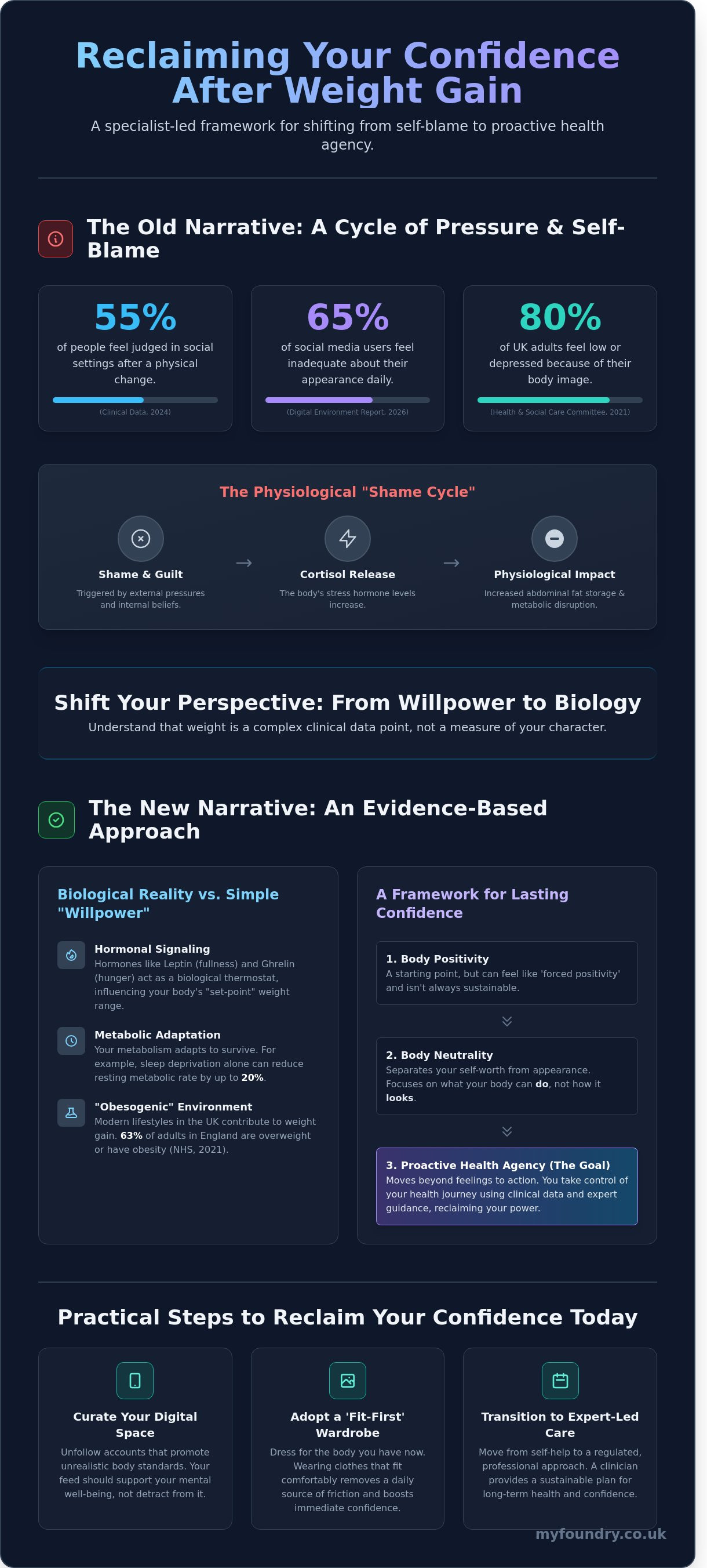
Editorial TeamWhat if the weight you've gained isn't a failure of willpower, but a complex biological data point that doesn't define your value? It's common to feel invisible in social settings or anxious about intimacy when your wardrobe no longer fits. If you're searching for how to feel confident after weight gain, you've likely realized that social media validation is a hollow substitute for genuine self-assurance. We understand that this transition is difficult. Clinical data from 2024 indicates that over 55% of people feel judged in social environments after a physical change, proving that your feelings are a valid response to external pressures.
You deserve a path that prioritizes medical evidence over aesthetic trends. This guide provides a specialist-led framework to help you reclaim your self-worth and transition from emotional distress to proactive health agency. We'll explore why 2026 is the year to move toward expert-led management and how to rebuild your identity through a clinical lens. From managing social anxiety to curating a wardrobe that supports your current body, we'll outline the exact steps to regain control of your long-term health journey through a regulated, professional approach.
Key Takeaways
- Understand that body image is a psychological construct rather than a literal reflection, helping you separate your core self-worth from the number on the scale.
- Shift your perspective from personal willpower to biological reality by learning how hormones like insulin and leptin influence your weight set-points.
- Discover a specialist-led framework for how to feel confident after weight gain by moving beyond forced positivity toward body neutrality and proactive health agency.
- Implement immediate environmental changes, such as curating your digital space and adopting a 'fit-first' wardrobe, to support your mental well-being today.
- Learn the clinical advantages of transitioning from self-help to a regulated, expert-led approach for sustainable health management and long-term confidence.
Understanding the Psychological Impact of Weight Gain on Self-Worth
Gaining weight often triggers a profound sense of identity loss. It isn't just about a change in clothing size; many people feel as though they've lost the person they used to be. Understanding how to feel confident after weight gain requires acknowledging that body image is a psychological construct. It's a mental map of how you perceive yourself, not a literal reflection in the mirror. A 2023 study published in the Journal of Health Psychology confirms that body dissatisfaction is more closely linked to internal self-perception than a person's actual Body Mass Index (BMI).
This internal friction often leads to a 'shame cycle'. When you feel shame about your body, your brain triggers the release of cortisol. High levels of this stress hormone are clinically linked to increased abdominal fat storage and metabolic disruptions. This creates a physiological barrier to wellness. In the digital environment of 2026, the 'validation trap' is more intense than ever. Algorithms prioritize filtered, unrealistic images that make 65% of social media users feel inadequate about their physical appearance on a daily basis.
The Link Between Body Image and Mental Wellbeing
Weight-related anxiety often bleeds into professional life. A 2022 survey found that 41% of UK employees felt their appearance impacted their confidence during meetings or presentations. This anxiety can lead to social withdrawal, where you avoid events until you reach a 'goal weight'. This 'waiting to be thin' mindset is a significant barrier to living a full life today. It's vital to distinguish between a healthy concern for your metabolic health and body dysmorphic disorder, which involves an obsessive focus on perceived flaws.
Deconstructing External Pressures in the UK
UK media standards frequently perpetuate narrow beauty ideals. A 2021 report by the Health and Social Care Committee revealed that 80% of UK adults feel low or depressed because of their body image. Weight stigma also exists within healthcare and social settings, often leading to biased treatment. Moving toward internal self-efficacy means valuing your body for its function and resilience rather than external feedback. Learning how to feel confident after weight gain involves shifting your focus from how others see you to how your body supports your daily life. Our clinicians focus on these internal health markers rather than just the number on a scale.
Shifting the Narrative: From Character Flaws to Biological Factors
Understanding how to feel confident after weight gain begins with a fundamental shift in perspective. Your weight isn't a reflection of your willpower or moral character. It's a complex biological outcome influenced by genetic predispositions and hormonal signaling. Clinical research shows that your body has a "set-point," which is a specific weight range it naturally attempts to maintain. When you deviate from this range, your biology often fights back through hormonal shifts. Hormones like ghrelin, which signals hunger, and leptin, which signals fullness, act as a biological thermostat. If these signals become imbalanced, maintaining weight becomes a physiological battle rather than a simple choice.
The Science of Metabolism and Weight Fluctuations
The "calories in versus calories out" model is often too simplistic because it ignores metabolic adaptation. Your body is designed to survive, not to meet modern aesthetic standards. For instance, a 2020 study published in Nature Communications highlighted how sleep deprivation can reduce resting metabolic rates by up to 20%. Chronic stress also triggers cortisol, a hormone that encourages the body to store fat around the midsection. Using a calorie calculator provides essential baseline data, but it's a tool for information, not a source of punishment. It's simply one metric to help you understand your body's energy requirements.
Clinical Agency: Taking Charge of Your Health Data
Viewing weight as a clinical data point removes the emotional burden of shame. The UK's current environment is often described as "obesogenic," where high-calorie foods are accessible and sedentary lifestyles are the norm. According to 2021 NHS statistics, 63% of adults in England are classified as overweight or living with obesity. This isn't a national failure of discipline; it's a systemic challenge. Seeking a medical weight loss UK programme offers a structured, clinician-led approach that replaces guesswork with evidence. By working with UK-registered prescribers, you can address the physiological drivers of weight gain. This professional oversight is a key step in learning how to feel confident after weight gain because it validates your experience through a medical lens. If you're ready to move beyond "quick fixes," you can start a consultation with our clinical team to explore a regulated pathway to wellness.
Mindset Frameworks: Body Positivity vs. Neutrality vs. Agency
Understanding your psychological approach is the first step in learning how to feel confident after weight gain. Most people are familiar with body positivity, which encourages unconditional love for your physical form. While this is a noble goal, it often feels like an unreachable standard when you're navigating a 5kg or 10kg weight shift. Forcing yourself to love a body you don't currently recognize can create a "positivity trap" that increases internal shame when you fail to meet that emotional benchmark.
Body neutrality offers a more clinical and grounded alternative. It removes the pressure to feel "good" about your looks. Instead, you focus on what your body does. You respect your heart for its 100,000 daily beats and your legs for their mobility. This perspective shifts the focus from aesthetic value to functional utility, which is often a more sustainable mental state during a health journey.
Clinical agency is the third framework, specifically designed for those who want to take an active role in their medical outcomes. It's the empowering realization that you can partner with UK-registered clinicians to manage your weight through regulated, evidence-based pathways. It isn't about "fixing" a flaw; it's about exercising your right to expert-led medical support.
Choosing the Right Framework for Your Mental Health
You don't have to choose just one mindset. Use body neutrality when you feel immediate emotional distress or face a mirror. It lowers cortisol levels by stopping the cycle of self-criticism. When you're ready for action, clinical agency provides the structure you need. By working with GPhC-regulated pharmacies and CQC-registered providers, you move away from the "quick fix" culture and toward a professional, long-term health plan.
The Role of Cognitive Reframing
Cognitive reframing is a psychological technique that identifies and disputes irrational thoughts to establish a more balanced sense of self-worth. It's particularly effective for breaking "all-or-nothing" thinking, where a person views a single weight fluctuation as a total failure. Research from the 2022 Journal of Health Psychology indicates that individuals who use reframing techniques are 40% more likely to maintain consistent health habits. You can practice this by replacing the identity-based statement "I am fat" with the clinical reality: "I am currently managing my metabolic health." This simple shift in language transforms a perceived personal failing into a manageable medical objective.
- Body Positivity: Focuses on emotional acceptance.
- Body Neutrality: Focuses on functional respect.
- Clinical Agency: Focuses on medical empowerment and regulated support.
Using these tools allows you to navigate your journey with a sense of control. It's about finding a better way to wellness that respects both your mental health and your clinical needs.
Practical Steps to Reclaim Your Confidence Today
Reclaiming your self-assurance is a clinical process as much as an emotional one. Start by auditing your digital environment. A 2021 study in the Journal of Health Psychology demonstrated that curating a social feed to include diverse body types leads to measurable improvements in body satisfaction within just four weeks. Remove accounts that promote unrealistic "fitspiration" and replace them with voices that focus on holistic wellness and medical reality. This reduces the constant, often subconscious, comparison that erodes self-esteem.
Movement should be about joy and function, not a punishment for what you've eaten. Engage in social exposure therapy by gradually returning to activities you've avoided, like swimming or group dining. Practice "Active Presence." This involves focusing entirely on external stimuli, such as the cadence of a friend's voice or the texture of your surroundings, rather than your own silhouette. It's a key strategy for how to feel confident after weight gain because it breaks the cycle of internal self-scrutiny.
Dressing for the Body You Have Now
Keeping "goal clothes" in your wardrobe creates a daily psychological hurdle. Clinical observation suggests that seeing items that don't fit triggers a shame response, which actively hinders health progress. Store these items away. Focus on British tailoring; well-fitted garments provide structural support that naturally improves your posture and presence. Investing in three or four high-quality basics ensures you feel professional and authoritative in every setting. Learning how to feel confident after weight gain often starts with the tactile comfort of clothes that don't pinch or restrict your movement.
Building Confidence Through Small Wins
Shift your focus to non-scale victories (NSVs). Track objective metrics like a 20% increase in daily energy levels or achieving seven hours of restorative sleep. These data points provide proof of health improvements that the scale cannot capture. Maintaining social connections is vital. Isolation often compounds body image distress and leads to poorer health outcomes. If you face "well-meaning" comments from others, use a prepared, clinical response: "I'm focusing on my long-term metabolic health right now." This sets a firm boundary while maintaining your dignity. If you're looking for expert-led support on your journey, you can start your clinical consultation with a regulated healthcare partner today.
How a Clinician-Led Approach Supports Long-Term Confidence
Transitioning from self-help strategies to professional clinical support marks a shift from trial-and-error to evidence-based care. When you have a UK-registered clinician in your corner, the psychological burden of managing weight alone disappears. This partnership is vital when learning how to feel confident after weight gain, as it replaces internalised shame with a structured, medical strategy. At Foundry Health, we focus on the biological realities of weight management rather than just willpower.
Modern treatments provide the biological momentum that lifestyle changes alone sometimes lack. Clinical data shows that medications such as Mounjaro UK (tirzepatide) or Wegovy UK (semaglutide) work by mimicking natural hormones to regulate appetite. For instance, semaglutide trials demonstrated an average weight loss of 15% over a 68-week period. These aren't "quick fixes" but regulated tools designed to support your metabolic health under expert supervision.
The Foundry Health philosophy prioritises safety and personalised care above all else. We understand that every patient's journey is unique, which is why our approach is built on three core pillars:
- Safety: Every prescription is subject to a rigorous clinical review.
- Regulation: We work exclusively with UK-registered pharmacies and prescribers.
- Personalisation: Your treatment plan is tailored to your specific medical history and health goals.
The Security of Regulated Medical Care
Safety is the foundation of our service. Operating under GPhC (General Pharmaceutical Council) and CQC (Care Quality Commission) standards ensures your care meets strict UK healthcare regulations. Unlike unregulated weight loss products, a clinician-led programme includes continuous monitoring. Understanding how to feel confident after weight gain becomes much easier when you know your health is being managed by professionals who conduct regular reviews of your progress and wellbeing.
Starting Your Journey to Wellness
Your professional consultation is a discreet, secure process where you can expect total dignity. You'll provide your medical history and current health metrics, allowing a prescriber to create a clear medical plan. There's no judgement here, only clinical expertise. As you move forward, remember that your value is inherent and does not fluctuate with the numbers on a scale. Your health is a long-term journey, and starting with a professional foundation is the most self-compassionate step you can take.
Take the Next Step Toward Lasting Wellness
Recognizing that weight changes are often driven by complex biological factors rather than personal failings is the first step toward a healthier outlook. When you focus on body neutrality and physical agency, you prioritize functional health over aesthetic perfection. Learning how to feel confident after weight gain involves moving away from restrictive cycles and toward a clinical framework that respects your body's needs. Expert medical guidance provides the stability required for long-term success, adhering to the evidence-based protocols established by the National Institute for Health and Care Excellence (NICE).
Foundry Health delivers a professional, expert-led experience through our team of UK-registered clinicians and our GPhC regulated pharmacy. We provide access to clinically-proven treatments that are monitored for safety and efficacy. Our process is fully transparent and follows the strict standards of the Care Quality Commission (CQC), ensuring you receive legitimate medical care instead of a temporary solution. You're not alone in this process, and you don't have to settle for anything less than professional support. Start your clinician-led weight loss consultation today. Your journey toward a more confident, healthier self begins with a trusted medical partnership.
Frequently Asked Questions
Is it normal to feel depressed after gaining weight?
Yes, it's clinically common to experience low mood or depressive symptoms following weight changes. Research in the International Journal of Obesity shows that individuals experiencing weight gain have a 25% higher risk of developing mood disorders. These feelings often stem from societal stigma and changes in hormonal balance. If these feelings persist for more than 14 days, you should consult a UK-registered clinician for a professional review.
How can I feel sexy after gaining weight in a relationship?
Prioritising emotional intimacy and sensory connection is the most effective way to maintain confidence in a relationship. A study in the Journal of Sexual Medicine found that 60% of relationship satisfaction is tied to emotional closeness rather than physical size. Openly discussing your feelings with your partner reduces anxiety. Learning how to feel confident after weight gain involves focusing on the quality of your connection rather than a specific number on the scale.
How do I deal with people noticing my weight gain?
You can manage unsolicited comments by setting clear, professional boundaries. If a colleague or friend mentions your appearance, a direct statement like "I'm focusing on my wellness right now and don't wish to discuss my weight" is effective. Data from the Weight Bias Network indicates that 40% of adults face such comments. Reclaiming control over the conversation protects your mental health and maintains your personal privacy.
How can I be confident in clothes after gaining weight?
Dressing for your current size immediately reduces the physical discomfort that triggers negative self-talk. Research indicates that 75% of individuals experience a significant mood lift when wearing clothes that fit properly. Avoid "hidden" sizes or waiting for a specific weight to buy new items. This practical adjustment is a vital step in learning how to feel confident after weight gain; it allows you to move comfortably and reduces cortisol spikes.
Why do I feel like a failure for gaining weight?
These feelings usually stem from internalised weight stigma rather than personal inadequacy. Clinical data suggests that 80% of weight management is influenced by genetics, hormones, and environment rather than simple willpower. You haven't failed; your body is responding to complex biological signals. Reframing weight management as a medical process rather than a moral one helps dismantle these feelings of guilt.
Can medical weight loss help my self-esteem?
Expert-led medical weight loss can improve self-esteem by shifting the focus from "quick fixes" to regulated health outcomes. Clinical trials for modern weight management treatments show that 70% of patients report a higher quality of life. When you work with UK-registered prescribers, you receive a plan designed for you. This professional support ensures your journey is safe, evidence-based, and focused on long-term wellness rather than just aesthetics.
How long does it take to get body confidence back?
Regaining body confidence typically requires 6 to 12 months of consistent psychological reframing. This isn't an overnight shift. A 2022 study found that individuals who practiced daily neutral body observation saw a 30% improvement in self-image within 90 days. Your brain requires time to update its internal representation of your body; patience is essential as you navigate this transition.
What are the first steps to take after gaining weight?
Your first step should be a clinical consultation to ensure no underlying medical conditions are impacting your weight. Once a clinician has reviewed your health markers, focus on sustainable habits rather than restrictive diets. The National Health Service reports that small, consistent changes are 50% more successful than drastic measures. Focus on hydration, 7 to 9 hours of sleep, and gentle movement to support your physical wellness.