

Calorie Calculator: A UK Guide to Your Daily Energy Needs (2026)
Editorial TeamNavigating the world of weight management can be overwhelming, especially with the volume of conflicting advice available. If you've found previous weight loss attempts unsuccessful or are unsure why progress has stalled, you are not alone. The crucial first step is often the simplest: understanding your body's unique energy requirements. A clinically-sound calorie calculator provides this essential starting point, cutting through the noise to offer a clear, personalised figure based on your own data.
This comprehensive 2026 UK guide is designed to do more than just give you a number. We will walk you through the process of calculating your daily calorie needs accurately, based on factors like your age, sex, activity level, and goals. More importantly, we will explain the fundamental principles of energy balance, empowering you with the medical understanding needed to make informed decisions for your health and wellness journey.
A calorie target is a powerful tool, but it is not a complete solution. This article will show you how to use that tool effectively, moving beyond the numbers to lay the groundwork for a sustainable, expert-led approach to achieving your long-term health goals. Consider this your clear starting point for taking control.
Key Takeaways
- Understand the principle of energy balance (calories in vs. calories out) as the foundation for effective weight management.
- A calorie calculator provides a personalised starting point, but its accuracy depends on an honest assessment of your daily activity level.
- Your calculated calorie target is a valuable guide, not a rigid rule; individual factors play a significant role in your journey.
- Learn to recognise when a calculated calorie deficit isn't leading to results, which may indicate a need for professional medical guidance.
What Are Calories and How Many Do You Really Need?
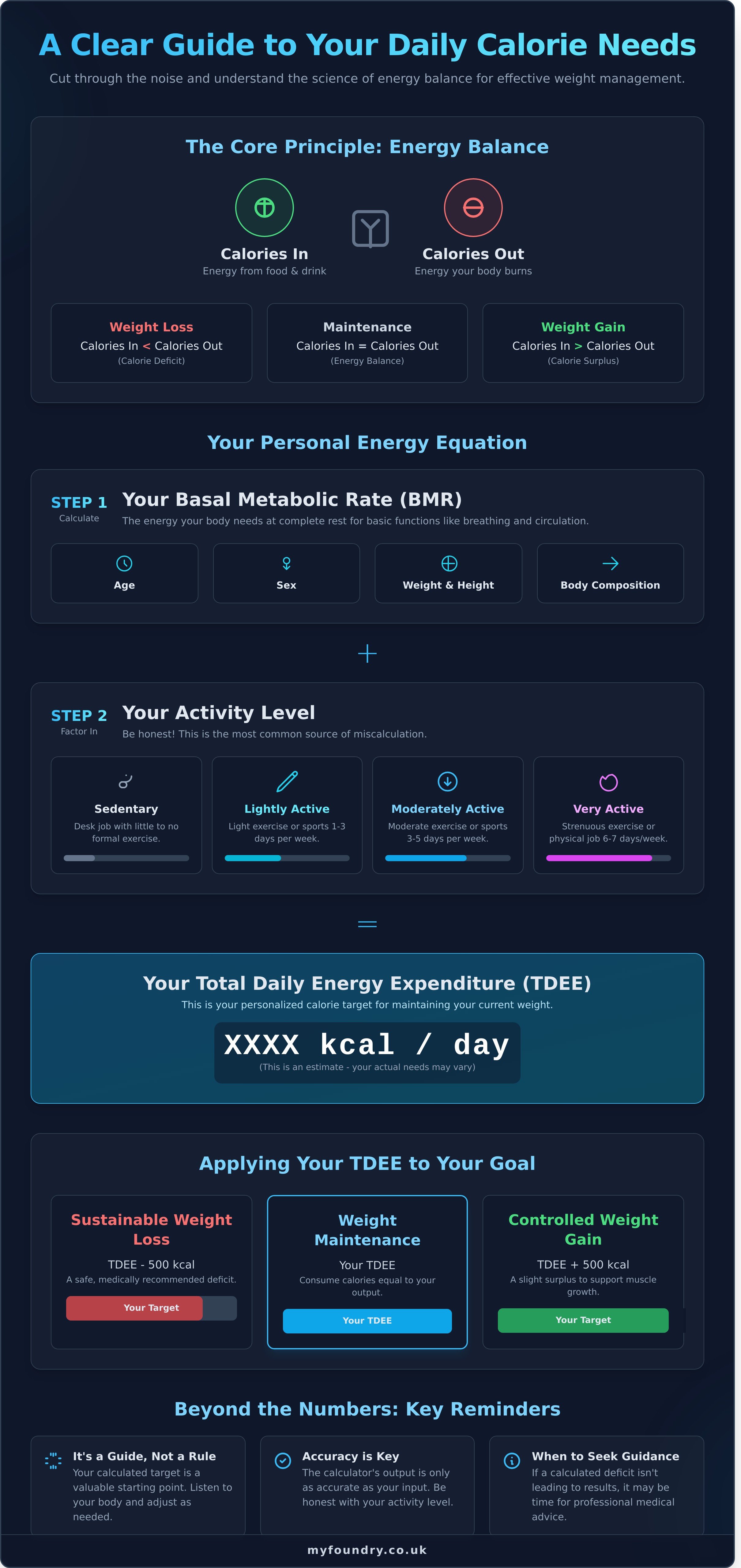
In nutritional science, a calorie is a unit of energy. Understanding what a calorie is reveals its fundamental role: it is the fuel your body uses to perform every function, from breathing and circulating blood to walking and thinking. Effective weight management is governed by the principle of energy balance—the relationship between the calories you consume (energy in) and the calories your body expends (energy out).
You may be familiar with the general UK guidance of 2,000 calories per day for women and 2,500 for men. While these figures serve as a basic population average, they are not a personalised prescription for health. Your individual energy requirements are unique, influenced by a range of factors that a one-size-fits-all number cannot account for. To achieve your health goals safely and sustainably, it is essential to determine a more accurate, personal target. This is precisely where a clinical calorie calculator can provide clarity.
Understanding Your Basal Metabolic Rate (BMR)
Your Basal Metabolic Rate (BMR) represents the minimum number of calories your body requires to perform its most basic, life-sustaining functions while at complete rest. Think of it as the energy cost of keeping your body running. The primary factors that determine your BMR include:
- Age: Metabolic rate tends to decrease with age.
- Sex: Men typically have a higher BMR due to greater muscle mass.
- Weight and Height: A larger body requires more energy to maintain.
- Body Composition: Lean muscle tissue burns more calories at rest than fat tissue.
It is clinically inadvisable to consume fewer calories than your BMR for a sustained period, as this can negatively impact your metabolism and overall health.
Factoring in Activity: From BMR to Your TDEE
While BMR is your baseline, your Total Daily Energy Expenditure (TDEE) is the more practical figure for weight management. TDEE is the total number of calories you burn in a 24-hour period, and it accounts for your BMR plus all physical activity. It is the most accurate reflection of your actual energy needs.
TDEE is calculated by multiplying your BMR by an activity factor. These levels generally include:
- Sedentary: Desk job with little or no formal exercise.
- Lightly Active: Light exercise or sports 1-3 days per week.
- Moderately Active: Moderate exercise or sports 3-5 days per week.
- Very Active: Strenuous exercise or a physical job 6-7 days per week.
By identifying your activity level, you can move from a baseline BMR to a comprehensive TDEE, giving you the key information needed to inform your nutritional choices.
How to Use a Calorie Calculator Accurately
A calorie calculator is a powerful tool for understanding your body's energy requirements, but its accuracy depends entirely on the information you provide. To get a reliable estimate of your Total Daily Energy Expenditure (TDEE) and set appropriate health goals, it is essential to follow a structured approach. The process involves gathering your personal metrics, making an honest assessment of your activity, and interpreting the results safely.
Start by entering your key data: age, biological sex, height, and current weight. These figures form the basis of the calculation. From there, you can determine your targets for weight maintenance, loss, or gain. It is crucial to remember that this tool provides a well-informed estimate based on established formulas; it is not a substitute for a medical diagnosis or personalised clinical advice.
Choosing Your Correct Activity Level
One of the most common mistakes is overestimating daily physical activity, which can lead to an inaccurate calorie target. For a precise calculation, it is vital to select the category that genuinely reflects your typical week, not your aspirational one.
- Sedentary: Desk-based work with minimal physical movement and little to no structured exercise.
- Lightly Active: Primarily sedentary work but includes light exercise such as walking or jogging for 1-3 days per week.
- Moderately Active: A job with extended periods of standing or walking (e.g., retail, teaching) or a sedentary job combined with moderate exercise 3-5 days per week.
- Very Active: A physically demanding role (e.g., construction worker, personal trainer) or intense, structured exercise for 6-7 days per week.
Setting a Safe and Sustainable Calorie Deficit
For effective and sustainable weight management, a gradual approach is medically recommended. A consistent deficit of approximately 500 calories per day typically results in a loss of around 1lb (0.45kg) per week, as 3,500 calories is roughly equivalent to one pound of body fat. We advise a daily deficit between 300-500 calories for safe and steady progress. This approach aligns with established UK daily calorie guidelines, which prioritise long-term health. Extreme deficits, particularly dropping below 1200 calories per day for women or 1500 for men, are not recommended without direct clinical supervision due to potential health risks and nutritional deficiencies.
Beyond the Numbers: Why a Calculator Is Only Part of the Story
A calorie calculator is an excellent tool for building awareness and establishing a baseline for your daily energy requirements. It uses established formulas to provide a clear, numerical target, which can be a powerful motivator for change. However, it's crucial to understand how calorie calculators estimate your needs and recognise that this figure is a starting point, not a definitive rule. Your body is a complex biological system, not a simple equation, and many individual factors can influence how it uses energy.
As you progress on your weight management journey, your body may undergo metabolic adaptation, where it becomes more efficient and burns fewer calories to perform the same tasks. This can lead to frustrating weight loss plateaus that are difficult to overcome with calorie reduction alone. Furthermore, our relationship with food is deeply psychological, shaped by habits, stress, and emotions—factors that a simple online calculator cannot measure or address.
Not All Calories Are Created Equal: The Role of Macronutrients
The source of your calories is just as important as the quantity. Your body processes the three main macronutrients—protein, fats, and carbohydrates—very differently. Protein, for instance, has a higher thermic effect, meaning your body uses more energy to digest it. It is also crucial for promoting satiety (the feeling of fullness) and preserving lean muscle mass during weight loss. Focusing on nutrient-dense foods like lean proteins, vegetables, and whole grains provides essential vitamins and minerals, whereas 'empty calories' from processed snacks and sugary drinks offer little nutritional value and can leave you feeling unsatisfied.
Hormonal and Medical Factors That Influence Weight
Underlying medical conditions and hormonal fluctuations can significantly impact your metabolism and ability to manage weight, making a standard calorie deficit less effective. Conditions such as an underactive thyroid (hypothyroidism) or Polycystic Ovary Syndrome (PCOS) can slow metabolic rate and alter how your body processes energy. Similarly, the hormonal shifts during perimenopause and menopause can lead to changes in body composition and fat storage, particularly around the abdomen. These clinical factors require a more nuanced, often medical, approach that goes far beyond simple calorie counting.
Ultimately, while a calorie target provides structure, true and sustainable weight management involves a holistic view. It requires understanding your unique physiology, the quality of your food, and the underlying factors that influence your health. Viewing the number from a calculator as one piece of a larger puzzle is key to long-term success.
Practical Steps for Using Your Calorie Target Effectively
The figure provided by a calorie calculator is a scientifically-informed starting point for your weight management journey. It is crucial, however, to view this number as a flexible guide rather than a rigid rule. True, sustainable progress is achieved by combining this data with an understanding of your own body and habits. A good first step is to track your normal food intake for one to two weeks without judgement. This provides a valuable baseline of your current energy consumption and dietary patterns.
While calories are a key part of the energy balance equation, the quality of those calories is paramount for your overall wellness. Prioritise whole, unprocessed foods such as fruits, vegetables, lean proteins, and whole grains. These foods are typically more nutrient-dense and satiating, helping you feel fuller for longer. It is also essential to listen to your body's physiological signals. Pay attention to genuine hunger and stop eating when you feel comfortably full, a practice that complements tracking by fostering a healthier relationship with food.
Choosing the Right Tools for Tracking
For detailed insights, digital applications like MyFitnessPal or Cronometer are popular in the UK and can track macronutrients alongside calories. However, a simple pen-and-paper food diary can be just as effective. The primary goal is not daily perfection but rather to recognise patterns and maintain consistency over time, allowing you to make informed adjustments to your diet.
When and How to Adjust Your Calorie Goals
As your body weight changes, your Total Daily Energy Expenditure (TDEE) will also decrease. It is therefore necessary to periodically adjust your intake. We recommend recalculating your needs using a reliable calorie calculator after every 10-15 lbs of weight loss. If you experience a weight loss plateau, it may be time to review your calorie target, activity levels, and dietary consistency. This is a normal part of the process where expert guidance can be particularly beneficial.
Successfully managing your weight is a dynamic process that involves data, self-awareness, and periodic adjustments. For those seeking a medically-supervised approach to navigate these steps, Foundry's expert-led programmes offer structured support designed for you.
When to Seek Professional Guidance for Weight Management
While a calorie calculator provides an excellent starting point for understanding your energy needs, it is a tool, not a complete solution. For many, a simple numbers-based approach is not enough to overcome complex biological and lifestyle barriers. If you have been diligently tracking your intake and find yourself struggling to see results, it may not be a lack of effort but an indication that a more comprehensive approach is required.
At Foundry, we believe in combining lifestyle insights with medical expertise to create a holistic plan designed for you. Professional support isn't a last resort; it's a strategic tool for ensuring your weight management journey is safe, effective, and sustainable for the long term.
Signs You May Need More Than a Calculator
A do-it-yourself approach may not be sufficient if you identify with any of the following situations:
- You have a significant amount of weight to lose: Managing a larger weight loss goal often requires structured medical supervision to ensure it is done safely and to address the unique metabolic challenges involved.
- You have a known medical condition: Conditions like Polycystic Ovary Syndrome (PCOS), type 2 diabetes, or thyroid issues can directly impact your metabolism, making a standard calorie deficit less effective without medical guidance.
- You have a history of yo-yo dieting: Repeated cycles of weight loss and regain can be frustrating and harmful. A clinician can help you build a sustainable, healthier relationship with food and your body.
- You feel stuck or frustrated despite your best efforts: If you are doing everything "right" but the scale is not moving, professional guidance can help identify underlying factors you may have missed.
How a Clinician-Led Programme Can Help
A medically supervised programme moves beyond basic calculations to offer a personalised and robust framework for success. A UK-registered clinician will conduct a comprehensive health assessment, looking at your full medical history, lifestyle, and individual biology to understand the complete picture.
This allows for a truly tailored plan that may, where clinically appropriate, include prescribed medical treatments to support your efforts with diet and exercise. Crucially, it provides the ongoing support and accountability needed to navigate challenges and make lasting changes. It is about having a medical expert in your corner, dedicated to your long-term wellness.
If you are ready to explore a more supportive and effective path to weight management, we are here to help. Start your confidential consultation with a UK-registered clinician.
From Numbers to Lasting Change: Your Path Forward
Understanding your daily energy needs is a crucial first step in any weight management journey. A calorie calculator provides a valuable, personalised baseline, but it's essential to remember that this number is just a guide. Factors like metabolic health, hormonal balance, and the quality of your nutrition are equally important. True, sustainable success comes from a holistic approach that considers your unique health profile and goes far beyond a simple calculation.
If you are ready to move beyond estimates and towards a plan designed for your body and your life, professional medical guidance can make all the difference. At Foundry, we specialise in creating personalised and medically-supervised weight management programmes. Led by UK-registered clinicians and fully regulated by the Care Quality Commission (CQC), our approach ensures you receive the highest standard of safe, effective, and supportive care. Start your online consultation with a Foundry clinician today.
Taking this step is a powerful commitment to your long-term health and wellness.
Frequently Asked Questions
How accurate are online calorie calculators?
Online calorie calculators provide a valuable estimate of your daily energy needs based on established scientific formulas. However, they are not perfectly precise as they cannot account for individual factors like genetics, body composition, and metabolic rate. It is best to view the result as an informed starting point for your weight management plan. You should then monitor your progress and adjust your intake based on real-world results to ensure a safe and effective approach.
Is it safe to eat 1200 calories a day to lose weight?
A 1200-calorie diet is a very low-calorie diet (VLCD) and is not considered safe or sustainable for most adults without direct medical supervision. Such a significant restriction can lead to nutrient deficiencies, fatigue, and the loss of lean muscle mass. In the UK, VLCDs are typically only undertaken for short periods under the guidance of a clinician for specific health reasons. A more moderate, sustainable calorie deficit is recommended for long-term health.
What is the best macronutrient ratio for weight loss?
There is no single macronutrient ratio that is "best" for everyone. A successful weight management plan depends on a sustainable, balanced diet. Many individuals find that a moderately higher protein intake is beneficial, as it can increase satiety (the feeling of fullness) and help preserve muscle mass during weight loss. The ideal ratio is one that you can adhere to consistently while consuming a variety of nutrient-dense, whole foods that support your overall health.
Can I lose weight without counting calories?
Yes, it is certainly possible to lose weight without tracking every calorie. Strategies such as managing portion sizes, focusing on nutrient-dense foods like vegetables and lean proteins, and practicing mindful eating can all create an energy deficit. While these methods do not involve numerical tracking, they work by implicitly reducing your overall calorie consumption. For some, this approach is more sustainable and less restrictive than meticulous calorie counting for long-term success.
Why have I stopped losing weight even though I'm in a calorie deficit?
This is known as a weight loss plateau and is a common experience. It can occur due to metabolic adaptation, where your body becomes more energy-efficient as you lose weight, thus lowering your daily calorie needs. It may also signal that small inaccuracies have crept into your food tracking or that your exercise expenditure is lower than estimated. Re-evaluating your intake and activity levels can often help overcome this temporary phase in your weight management journey.
How often should I recalculate my calorie needs?
It is advisable to recalculate your calorie needs after a significant change in your body weight, such as losing 5-10% of your starting weight. As your body mass decreases, your metabolic rate also lowers, meaning you require fewer calories to maintain your new weight. You should also use a calorie calculator to reassess your needs if there is a substantial, long-term change in your physical activity levels, whether it's an increase or a decrease.
Does exercise mean I can eat more calories?
Physical activity increases your total daily energy expenditure (TDEE), meaning you burn more calories throughout the day. This can allow you to eat more while remaining in a calorie deficit for weight loss. However, it is important to note that fitness trackers and exercise machines often overestimate the number of calories burned. A successful weight management strategy combines a well-managed diet with regular physical activity, rather than using exercise solely to justify a higher calorie intake.